
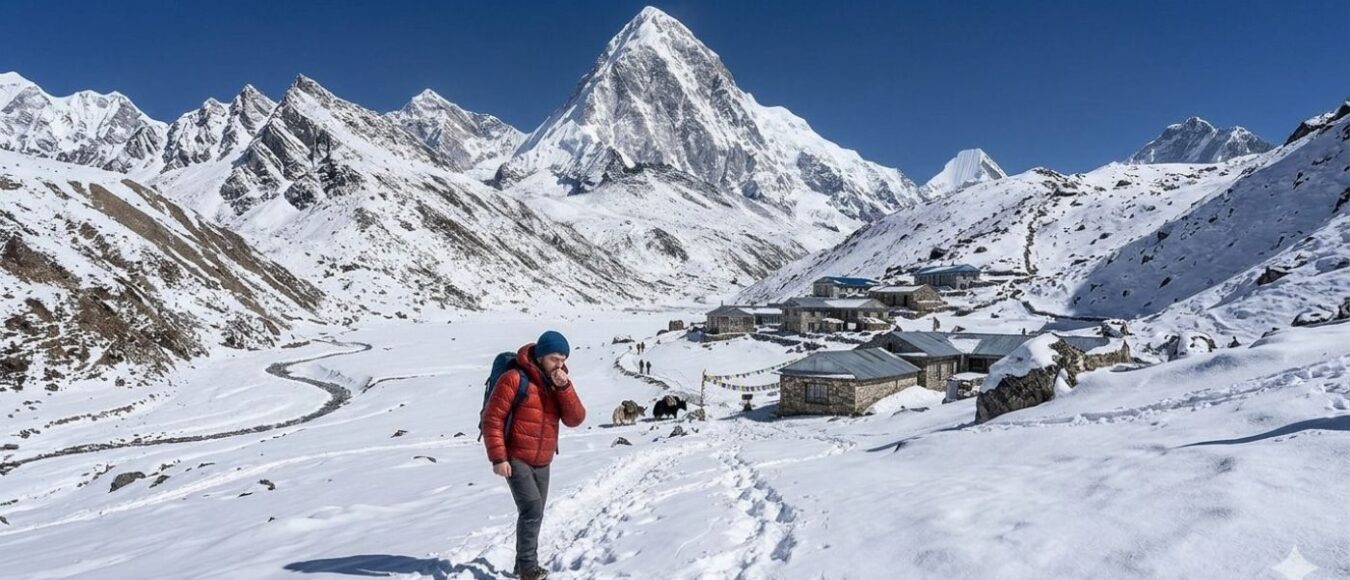
Khumbu Cough
Summary: Khumbu cough is a persistent, dry cough caused by cold, dry air and exertion above 3,500m, common on the Everest trek but distinct from altitude sickness. Symptoms worsen at night and can progress to chest discomfort or rib fractures if ignored. Prevention includes nose breathing, using a buff or mask, and staying hydrated, while red flags like pink mucus or breathlessness at rest require immediate descent.
Khumbu Cough Symptoms and Treatment
Khumbu cough is not a mystery illness. It is a well-documented altitude-related cough that affects trekkers and climbers in the Khumbu region and beyond. The cold air, low humidity, exertion, and reduced oxygen at high altitude all play a role. Understanding what it is, and what it is not, makes a genuine difference to how you handle your trek.
By the fifth day out of Dingboche, a dry tickle settled at the back of my throat. I dismissed it as trail dust, drank a little more water, and kept moving. But by morning, the cough had me awake at 3 a.m., staring at the teahouse ceiling. It was one of the most common and least discussed challenges on the Everest trail, and it blindsided me.
This guide covers the symptoms of Khumbu cough, what drives it, how it progresses, and when you should take it seriously. Whether you are planning your first Everest Base Camp trek or already on the trail, the team at Nepal Hiking Adventure has put this together to help you make clear-headed decisions at altitude.


2. What Is Khumbu Cough?
2.1 Simple Definition for Trekkers
Khumbu cough meaning in plain terms: it is a persistent cough triggered by the harsh environmental conditions found at high-altitude locations, particularly in the Everest region of Nepal. It is not caused by a virus or bacterial infection, though those can sometimes develop alongside it. The airways simply react to air that is too cold, too dry, and too thin for comfort.
- Common among trekkers heading above 3,500 metres
- Can develop gradually over several days or appear suddenly after a hard day
- Often described as a persistent hacking cough that worsens at night and during altitude gain
2.2 Why It Is Common in the Everest Region
The Everest region sits at elevations where the air holds far less moisture than at sea level. Trekking at high altitude means breathing in large volumes of this dry, cold air, particularly when the body is under exertion. The respiratory tract simply was not built for sustained exposure to these conditions.
Research adds useful context here. The first formal study of cough at high altitude took place during the 1994 BritishMount Everest expedition when 10 subjects trekked from 2800 m to Everest Base Camp at 5300 m and underwent nocturnal cough frequency monitoring. The findings were clear: cough frequency increased with increasing altitude. A separate study of cough at high altitude also examined Mount Everest in ahypobaric chamber setting through Operation Everest II and III, and long-duration hypobaric chamber studies confirmed the same pattern. Notably, cough frequency increased with increasing elevation in controlled conditions as well.
- Khumbu cough is common above Dingboche (4,410 m)
- Prevalence increases with increasing altitude throughout the trek
- The Himalayas present some of the most demanding respiratory conditions of any trekking destination

2.3 Is It Dangerous or Just Annoying?
Honestly, for most trekkers, it is deeply annoying rather than immediately dangerous. A mild cough that stays mild and does not worsen with elevation is generally manageable. However, conclusions drawn are that altitude-related cough exists and its prevalence rises sharply above base camp elevation and that research into altitude-related cough remains limited despite how widely cough affects those on the trail.
| Severity Level | What It Feels Like | General Risk |
| Mild | Dry tickle, occasional clearing of throat | Low, monitor only |
| Moderate | Regular coughing, discomfort at night | Moderate and manage actively |
| Severe | Bad khumbu cough, constant, painful | High, consider descent |
3. What Causes Khumbu Cough at High Altitude?
3.1 Cold Air and Lung Irritation
Cold air is the most immediate irritant. At altitude, temperatures drop sharply, and when you breathe cold air in volume during a long walking day, the lining of your airways responds. The bronchi constrict slightly, mucus production changes, and the cough reflex becomes more sensitive. A buff or neck gaiter that prevents cold air from reaching the throat directly makes a noticeable difference.
3.2 Dry Air and Low Humidity
Dry air strips moisture from the respiratory tract with every breath. At sea level, inhaled air picks up moisture in the nasal passages before reaching the lungs. The system becomes overwhelmed at high altitude.The mucous membranes dry out and become inflamed, and the cough reflex fires more easily. This is why dry air is consistently cited as a primary driver of altitude cough.
3.3 Mouth Breathing While Trekking/Walking
When the climb gets steep, most trekkers switch to mouth-breathing without realising it. The mouth offers no filtration, no humidification, and no warming of incoming air. That means cold, dry, unfiltered air hits the lower respiratory system directly. Possible perturbations in the cough response begin here. The perturbations in the cough reflex are not fully understood, but research suggests the cough reflex arc that may be disrupted by altitude exposure contributes significantly to the problem.
3.4 Dust on Popular Trails
The trails between Lukla and Everest Base Camp see significant foot, yak, and porter traffic. Fine dust is a constant companion, particularly in the dry season. For trekkers already dealing with an irritated respiratory tract, dust makes it considerably worse.
3.5 Altitude-Related Breathing Changes
As you gain elevation, the body works harder to extract oxygen from thinner air. Breathing rate increases, tidal volume changes, and the airways are simply processing more air per hour than they would at a lower altitude. This increased throughput accelerates irritation. Furthermore, research from the simulated ascent of Mount Everest confirmed that cough may be partly driven by changes in how the cough reflex operates under hypoxic conditions, not just mechanical irritation alone.

4. What Are the Early Symptoms of Khumbu Cough?
4.1 Dry, Persistent Cough
The defining feature is a dry, scratchy cough that does not produce much mucus, at least not early on. It tends to come in short bursts during the day and lengthen at night. Include a persistent dry cough in your list of things to monitor from day one above Dingboche, because catching it early gives you more options.
- Dry cough that produces little or no phlegm
- Worsens after long walking days with heavy breathing
- Often accompanied by a sensation of tightness in the chest
4.2 Throat Irritation and Tightness
Before the cough fully develops, many trekkers notice a raw, scratchy feeling at the back of the throat. Swallowing becomes slightly uncomfortable. This is the respiratory tract reacting to sustained exposure to cold air and dry air. At this stage, intervention is straightforward and effective.
4.3 Chest Discomfort During Breathing
As cough frequency increases, the muscles around the chest get a workout they did not train for. Mild chest soreness is common. In more serious cases, trekkers who suffered from cough at extreme intensity over several days have experienced rib fractures from the sheer force of repeated coughing. This is rare, but it illustrates how a bad khumbu cough can escalate beyond discomfort.
4.4 Night-Time Cough That Disrupts Sleep
Nocturnal cough frequency increased in multiple research studies as trekkers gained elevation. At night, lying flat changes how secretions pool in the airways. Warm teahouse air mixed with residual dust and dry conditions creates a cycle where the cough wakes you every hour. Poor sleep at altitude compounds every other symptom you are dealing with.
- Sleep disruption weakens the body’s ability to acclimatise
- High-altitude hack episodes are more frequent between midnight and 4 a.m.
- A slightly elevated sleeping position can reduce nocturnal episod

5. How Do Symptoms Progress If Ignored?
5.1 From Mild Cough to Severe Irritation
A mild, occasional cough on day three can become a persistent hacking cough by day six if nothing changes. The airways become progressively more inflamed. Therefore, each coughing episode irritates the lining further, which in turn lowers the threshold for the next episode. Hacking cough experienced at this level is exhausting and can make eating, sleeping, and walking all harder.
- Inflammation builds gradually, not all at once
- Trekkers who push through without managing symptoms often find the cough doubles in intensity above 4,500 metres
- A dry cough that intensifies with altitude gain is a reliable warning signal
5.2 Impact on Sleep and Energy Levels
Sleep is when the body repairs and adjusts. When nocturnal cough frequency is high, that process breaks down. Trekkers start each day already fatigued. Energy reserves deplete faster. Appetite drops. The compounding effect becomes significant by the time you reach Lobuche or Gorak Shep.
| Day Range | Typical Cough Pattern | Impact on Trek |
| Days 1–3 above Dingboche | Mild, occasional | Minimal |
| Days 4–6 | More frequent, drier | Sleep disrupted |
| Days 7+ without management | Persistent, painful | Trek threatened |
5.3 When It Starts Affecting Your Trek
The moment managing symptoms requires you to stop and rest repeatedly during walking hours, the cough has crossed from manageable to problematic. Consequently, this is the point where a conversation with your guide becomes necessary. It is not failure to acknowledge this. It is good mountain sense.

6. How Is Khumbu Cough Different from Altitude Sickness?
6.1 Key Differences in Symptoms
Altitude sickness covers a broader set of symptoms that affect the brain and body systemically. Khumbu Cough, by contrast, is localised to the respiratory system. The two conditions can occur together, but understanding which is which matters for how you respond.
| Symptom | Khumbu Cough | Altitude Sickness |
| Cough | Yes, primary symptom | Sometimes present |
| Headache | Rarely | Common |
| Nausea | No | Common |
| Breathlessness at rest | Unusual | Yes |
| Confusion | No | Serious sign |
| Chest tightness | Mild, from coughing | Possible with HAPE |
Note: This comparison is a general reference only. Symptoms at high altitude can overlap, develop quickly, or present differently from person to person.
6.2 When Cough Signals a Bigger Problem
Altitude-related cough is a symptom that sits on a spectrum. A cough alone is usually manageable. However, if a cough appears alongside headache, nausea, or unusual breathlessness at rest, the picture changes. These combinations may indicate altitude sickness of a more serious type, particularly high-altitude pulmonary oedema.
6.3 Red Flags You Should Not Ignore
- Coughing up pink or frothy mucus
- Breathlessness that does not ease with rest
- Gurgling or rattling sound when breathing
- Confusion or inability to walk a straight line
These are not khumbu cough symptoms. These are signs of something more serious, and descent is the only correct response.
7. Can Khumbu Cough Turn into Something Serious?
7.1 Risk of Chest Infection
Prolonged high-altitude cough leaves the airways raw and vulnerable. Bacteria that would normally be cleared more easily find purchase in inflamed tissue. Secondary chest infections are a genuine risk for trekkers who dismiss early symptoms. Furthermore, cough can result in rib fractures in extreme cases when the force is sustained and violent over many days, though this remains uncommon.
7.2 Link with Acute Mountain Sickness (AMS)
Sub-clinical high-altitude pulmonary oedema is one theory behind why some trekkers develop unusually severe Khumbu cough. The airways may accumulate small amounts of fluid, not enough to cause obvious breathing distress, but enough to drive coughing. This is distinct from overt altitude sickness but sits in the same physiological neighbourhood.
7.3 When to Seek Medical Help
- Symptoms become unbearable or worsen rapidly over a few hours
- Fever develops alongside the cough, suggesting infection
- Cough medicine and rest produce no improvement after 24 to 36 hours
- Any of the red flags in Section 6.3 appear
Trekkers and climbers on the Everest Base Camp route have access to the Himalayan Rescue Association clinic at Pheriche (4,371 m). Do not hesitate to use it. The Mount Everest base camp approach has medical resources specifically because it is predictable, known terrain for health challenges.
8. How Can You Prevent Khumbu Cough While Trekking?
8.1 Breathing Through the Nose
Nose breathing is the single most effective daily habit for preventing khumbu cough. The nasal passages warm and humidify incoming air before it reaches the lungs. On flat or moderate sections of trail, make a conscious effort to keep the mouth closed. On steeper climbs, that becomes harder, but even partial nose breathing helps.
- Reduces the volume of cold, dry air hitting the airway directly
- Filters dust particles before they reach the lower respiratory tract
- Supports better oxygen uptake through controlled breathing rhythms
8.2 Using a Buff or Mask
A buff worn over the nose and mouth creates a small pocket of warmer, slightly humidified air. It also prevents cold air from entering the airway at full force during cold mornings and windy ridge sections. Everest climbers and experienced trekkers on the Nepal trails have used this simple technique for decades. It costs nothing to implement and makes a noticeable difference above 4,000 metres.
8.3 Staying Hydrated in Dry Conditions
Hydration directly affects how well the mucous membranes of the respiratory system function. Dehydrated airways become drier, more brittle, and more reactive. Drink consistently throughout the day on any Everest trek, not just when thirst signals kick in. At altitude, thirst is often suppressed even when fluid needs are high.
- Target three to four litres of water daily above 3,500 metres
- Warm liquids, ginger tea, and lemon-honey water are practical teahouse options
- Avoid excessive caffeine and alcohol, both of which accelerate fluid loss
8.4 Choosing the Right Trekking Pace
Pacing affects breathing rate, and breathing rate affects how hard the airways work. A rushed ascent forces heavier mouth breathing and greater air volume through an already-stressed system. The standard acclimatisation rule of climbing high and sleeping low applies directly here. A conservative pace is one of the best trekking health tips you will receive.
8.5 Avoiding Dust Exposure
- Walk toward the front of your group on heavily trafficked trail sections
- Let yak trains pass and wait for the dust cloud to settle before following
- On windy days below treeline, a simple dust mask or tight buff reduces inhalation significantly
- Rinse the nasal passages with saline spray in the evening to clear accumulated dust
9. What Are the Best Remedies for Khumbu Cough?
9.1 Immediate Relief Methods on the Trail
When the cough hits mid-trail, there are practical options. Steam inhalation at teahouses, inhaling over a cup of hot tea, can briefly soothe irritated passages. Humming and slow nasal breathing helps reset an overactive cough response. Resting out of the wind during breaks reduces further irritation. These are not cures, but they reduce cumulative damage.
9.2 Medicines That Help (Lozenges, Syrups)
Over-the-counter cough suppressants are commonly carried and used by trekkers and climbers on the high-altitude trails of Nepal. Soothing lozenges with menthol or honey provide short-term relief. Codeine-based cough syrups, available in Kathmandu pharmacies, are a stronger option some trekkers carry for emergencies. Discuss options with a doctor before your trek, especially if you have asthma or other respiratory conditions.
| Remedy Type | Best Use Case | Availability on Trail |
| Menthol lozenges | Day-to-day throat soothing | Most teahouses stock them |
| Honey lemon tea | Immediate warmth and coating | All teahouses |
| Saline nasal spray | Dust clearance and hydration | Carry from Kathmandu |
| Cough syrup | Moderate to severe cases | Carry from Kathmandu |
| Steam inhalation | Night-time relief | Teahouse kitchens |
Note: The medical information in this guide is for general awareness only. Real trail conditions vary, and individual responses to high altitude differ. Always consult a qualified medical professional before your trek and follow the advice of your guide on the ground.
9.3 Natural Remedies Used by Trekkers
Local ginger tea with honey is the most trusted trail remedy and for good reason. Ginger reduces airway inflammation, honey coats the throat, and the warmth of the liquid provides immediate comfort. Turmeric milk, available at some higher lodges, is also used. Neither replaces cough medicine in serious cases, but both support the airways through a long trekking day.
9.4 When Rest Is the Only Solution
Sometimes the airways simply need a day without exertion. A rest day at a given elevation, built into your itinerary, gives the body a chance to adjust. If the cough is disrupting sleep and leaving you exhausted, pushing forward is counterproductive. Rest is not lost time. On a high-altitude trek like Everest, it is active acclimatisation.

10. What Should You Pack to Prevent Khumbu Cough?
10.1 Essential Gear Checklist
Packing the right items before you leave Kathmandu is one of the simplest ways to stay ahead of Khumbu Cough on the trail. This essential gear checklist covers everything your airways will thank you for above 3,500 metres.
- Buff or balaclava for airway protection in cold and wind
- Saline nasal spray to hydrate and flush the nasal passages daily
- Throat lozenges (Menthol or honey-based) carry more than you think you need
- Cough syrup (pre-purchased in Kathmandu with medical guidance)
- Insulated water bottle to keep water warm enough to drink consistently
- Small personal humidifier if budget allows for longer expeditions
10.2 Clothing That Protects Your Lungs
The right layering system reduces how much cold air the body is exposed to overall. A good mid-layer and a windproof outer shell make early morning starts considerably less harsh on the airways. A balaclava that covers the mouth and nose is more effective than a standard hat and separate buff.
- A down jacket for teahouse evenings when temperatures drop sharply
- Merino wool base layers, which regulate temperature without synthetic odour
- Windproof gloves to keep hands warm, reducing overall cold stress on the body
10.3 Small Items That Make a Big Difference
- Lip balm reduces cracking around the mouth, a common irritant
- A small notebook for tracking symptom patterns across days
- Electrolyte tablets to support hydration levels alongside plain water
- A thermometer, basic but useful for ruling out fever alongside cough
11. When Should You Stop Trekking Due to Khumbu Cough?
11.1 Signs You Need Rest or Descent
Knowing when to stop is the most important decision a trekker makes at altitude. Generally, a cough alone is not a reason to descend. However, the following signs shift that calculation:
- Cough accompanied by high fever, suggesting secondary infection
- Pain when breathing deeply, beyond normal chest muscle soreness
- Coughing producing blood or pink-tinged mucus
- Significant breathlessness at rest that is new or worsening
11.2 When to Consult a Guide or Doctor
Your guide watches dozens of trekkers a season and recognises the difference between normal altitude adjustment and something more serious. If you are uncertain, ask. The HRA clinic at Pheriche exists for exactly this purpose. A pulse oximeter reading below 80 at rest above 4,000 metres warrants a conversation with a medical professional before continuing.
- Do not self-diagnose serious symptoms at high altitude
- Guides carry basic medical training on reputable treks with agencies like Nepal Hiking Adventure
- When in doubt, descend first and assess from lower altitude
11.3 Making Safe Decisions at High Altitude
The mountain is not going anywhere. A descent of 500 to 1,000 metres often resolves symptoms within hours. For those planning longer routes such as the Everest Three Passes Trek, Manaslu Circuit Trek, or Kanchenjunga Base Camp Trek, understanding your personal cough threshold before you leave is essential. Build more rest days into harder itineraries, not fewer.

12. How Do Guides and Locals Handle Khumbu Cough?
12.1 Common Practices on Everest Trails
Experienced guides on the Everest Base Camp trail monitor trekkers’ breathing and cough patterns from day one. They track whether a cough is new, worsening, or changing character. Many carry basic medications and make note of rest stops. The daily check-in, pulse oximeter reading and a few questions over morning tea are practical systems that catch problems early.
- Guides slow the group pace when multiple trekkers show respiratory symptoms
- Extra rest stops are factored into the day’s schedule without announcement
- Teahouse owners along the route are familiar with the condition and stock relevant remedies
12.2 Sherpa Advice You Should Follow
Sherpas who have spent years at altitude understand acclimatisation in ways that no textbook fully captures. Their standard advice is simple: drink more than you think you need, walk slower than you want to, and sleep at a lower altitude whenever the schedule allows it. On days when the cough is worse, they often recommend skipping the morning start and resting until noon. That quiet adjustment can save the rest of the trek.

12.3 Real Trekking Insights
A trekker heading up from Dingboche (4,410 m) toward Lobuche once described it this way: every breath felt like swallowing cold gravel by the second hour. The guide handed over a buff, told her to breathe through it and slow down. By the time the group reached the teahouse, the coughing had eased. She reached Everest Base Camp two days later without further trouble. That small adjustment, made early, mattered entirely.
- A high-altitude cough on the mount everest expedition trails is expected, not exceptional
- Local knowledge and early intervention consistently outperform last-minute descents
- Everest base camp khumbu cough patterns are well understood by experienced local crews
Managing Khumbu Cough on Your Everest Trek
Khumbu Cough is part of the honest reality of trekking in the Everest region. It is not something to fear, but it is something to prepare for. The combination of cold air, dry air, dust, and altitude places real demands on the respiratory tract, and understanding those demands before you set foot on the trail gives you a meaningful advantage. Most trekkers who develop the cough manage it well and reach their goals.
The key is early recognition and sensible action. Knowing your khumbu cough symptoms, carrying the right items, breathing consciously, staying hydrated, and listening to your guide. These are not complicated steps. They are the difference between a cough that is a footnote in your trek diary and one that forces a difficult decision at 5,000 metres. Good preparation and training make the trail considerably kinder.
The Himalayas will test you in ways a training hike at sea level cannot replicate. But that is also what makes arriving at Mount Everest base camp so meaningful. If you are ready to trek with a team that understands every challenge the Everest region throws at you, contact Nepal Hiking Adventure today. The cough is manageable, the experience is worth every step, and we are here to make sure you reach it safely.

14. Khumbu Cough: FAQs
14.1 What is Khumbu cough, and why does it happen?
Khumbu cough is a high-altitude cough caused by sustained exposure to cold, dry, and thin air in the Khumbu region and surrounding Everest trails. The respiratory tract reacts to these conditions by becoming inflamed and hypersensitive, triggering a persistent cough that many trekkers and Everest climbers experience above 3,500 metres. Research, including the Mount Everest expedition when 10 subjects underwent testing, confirmed that cough frequency increased with increasing altitude, making it a predictable part of the high-altitude environment.
14.2 Is Khumbu cough dangerous during the Everest Base Camp trek?
For most trekkers, Khumbu Cough is uncomfortable but not dangerous on its own. The risk increases when it is severe, prolonged, or accompanied by symptoms that may indicate altitude sickness, such as breathlessness at rest, confusion, or pink-tinged mucus. A mild cough that stays mild can generally be managed with hydration, rest, and basic remedies throughout the Everest Base Camp trek.
14.3 How long does Khumbu cough last?
Most cases ease within a few days of descending to a lower altitude, where air is warmer, more humid, and richer in oxygen. On the trail, symptoms often plateau rather than worsen once acclimatisation stabilises. Trekkers who return to Nepal’s lower valleys typically find the cough resolves within one to two weeks, sometimes sooner.
14.4 What is the fastest way to relieve Khumbu cough?
The fastest relief on the trail comes from a combination of warmth, hydration, and reduced airway exposure to cold air. Breathing through a buff, drinking hot ginger or honey tea, and resting in a warm teahouse for an hour can reduce cough intensity noticeably. Over-the-counter cough suppressants and lozenges support managing symptoms through longer stretches. A significant drop in elevation, even 300 to 500 metres, produces the most rapid improvement of all.
14.5 Can I continue trekking with Khumbu cough?
Yes, in most cases. Altitude-related cough is a symptom that many trekkers carry to the top and manage throughout. The question is severity. If the cough is disrupting sleep significantly, causing chest pain, or if symptoms become unbearable, a rest day or partial descent is the right call before continuing. Trekking with a known, reputable agency means having a guide who can help you make this judgement accurately.
14.6 How do I prevent Khumbu cough before my trek?
Start preventing Khumbu cough before you leave home by ensuring your lungs are in good condition. Cardiovascular fitness helps. Packing a buff, saline spray, lozenges, and a cough syrup prepared in Kathmandu gives you practical tools from day one. On the trail, breathe through the nose where possible, stay well hydrated, walk at a controlled pace, and build rest days into your itinerary. These trekking health tips collectively reduce both the likelihood and the severity of the cough during your high-altitude trek.


Our History in Service Excellence


