
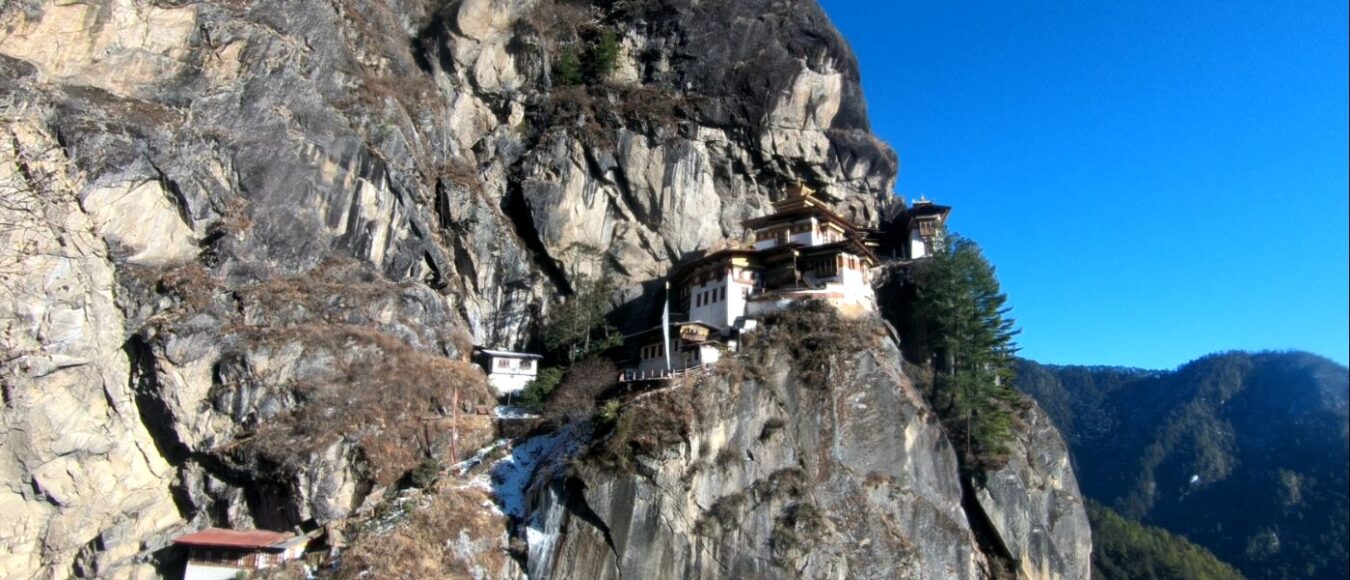
Tiger Nest Monastery
Summary: Tiger’s Nest Monastery (Paro Taktsang), Bhutan’s 17th-century cliff temple, sits 900 m above Paro Valley at 3,120 m. The hike takes two to three hours one way through pine forest, past a midway café, a gorge crossing, and roughly 700 stone steps to the entrance. A licensed guide and acclimatisation are essential; spring and autumn bring the clearest views. Photography is banned inside, but the trail and exterior offer striking, respectful access to this sacred Buddhist pilgrimage site.
Understanding Tiger Nest Monastery
Tiger Nest Monastery, officially known as Paro Taktsang, is a 17th-century Buddhist cliff monastery built into a granite rock face in western Bhutan, sitting 900 meters above the Paro Valley floor at 3,120 metres elevation. It comprises four main temples, several meditation caves, and interconnecting staircases carved directly from the mountain. The site functions as both an active place of worship and the most widely recognized sacred site in Bhutan.
The spiritual significance of the monastery runs deeper than its architecture. Tradition holds that Guru Rinpoche, also known as Padmasambhava, flew to this cliff on the back of a tigress and meditated here for three months. This event is considered central to the arrival of Vajrayana Buddhism in Bhutan. That founding legend explains why Paro Taktsang holds such authority in Bhutanese religious and cultural life and why it remains the most visited nest in Bhutan for pilgrims and travelers alike.
This guide by Nepal Hiking Adventure is written for international travellers seeking clear, practical information. Bhutan is a tiny Himalayan kingdom that controls its tourism deliberately, limits visitor numbers, enforces daily tariffs, and requires licensed guides. In practice, a visit to this iconic monastery follows a structured approach despite the dramatic setting. Whether you are assessing the Tiger’s Nest hike against your fitness level, choosing the best time to visit, or understanding what to expect inside the monastery, the information here is laid out clearly and in order.
History and Cultural Significance
Origins and Sacred Legend of Guru Rinpoche
The history and significance of Tiger’s Nest begins in the 8th century. Guru Rinpoche, revered across the Himalayan world as the second Buddha, is said to have flown to this site on the back of a tigress transformed from one of his consorts. He then entered a cave now known as Taktsang Pelphug and spent three months in meditation. That act of deep spiritual practice is widely credited with having brought Buddhism to Bhutan.
The name Paro Taktsang translates roughly as “Tiger’s Lair of Paro”, a direct reference to that founding legend. As a result, the site became a place of Buddhist pilgrimage long before any permanent structures were built. It was not until 1692 that the Fifth Desi Zhabdrung, Tenzin Rabgye, commissioned the construction of the monastery complex that stands today. The buildings were destroyed by fire in 1998 and subsequently restored to their original form, reopening in 2004.


Buddhism and the Monastery’s Role in Bhutanese Spiritual Life
Taktsang Monastery still functions as a monastery in the fullest sense. Monks live and practise here year-round. Religious ceremonies are held regularly, and Bhutanese pilgrims climb the trail throughout the year, often barefoot and carrying offerings. This is not a tourist destination for them. It is among the nation’s most sacred sites.
Buddhism arrived in Bhutan through the influence of figures like Padmasambhava, and Taktsang remains the physical anchor of that history. Furthermore, the monastery belongs to the Nyingma school, the oldest of the four main Tibetan Buddhist schools. Several of the caves within the complex are associated directly with Guru Rinpoche and remain sacred meditation spaces.
The Monastery’s Architecture and Cliffside Setting
Tiger’s Nest is built directly into and around a natural rock overhang, using the cliff face as both foundation and wall. The complex spans four main temples across different levels, connected by a series of steep internal staircases. Whitewashed walls, golden rooftops, and strings of prayer flags stretching across the gorge give the structure an almost suspended quality.
The architectural achievement is considerable given the terrain and the era. Stone, timber, and clay were all carried up the mountain by hand. The current structure, following the 1998 restoration, is faithful to the original design in both layout and material.
Where Tiger Nest Monastery Is and How to Get There
Location in Paro Valley and Elevation
Tiger Nest Monastery sits above the upper Paro Valley in western Bhutan, roughly 10 kilometres north of Paro town. The trailhead sits at approximately 2,600 metres above sea level. The monastery itself reaches 3,120 metres. The altitude difference between the valley floor and the monastery is around 900 metres, which is the primary physical challenge of the hike.
Best Routes to Reach the Trailhead
There is one main trail to Tiger’s Nest, starting from the designated car park near the base of the mountain. The path climbs through blue pine and rhododendron forest before opening to exposed ridgelines with increasingly clear views of the cliff and monastery above. There are no official alternative routes for general visitors.
Transport Options from Thimphu and Paro Town
| Departure Point | Distance to Trailhead | Approximate Travel Time | Common Transport |
| Paro Town | 10 km | 20 minutes | Car or taxi |
| Paro International Airport | 12 km | 25 minutes | Car or taxi |
| Thimphu | 65 km | 90 minutes | Car via Paro highway |
Your Bhutan travel arrangements will almost certainly include a licensed guide and vehicle, as both are required under current regulations for international visitors. Transfers to the trailhead are typically included in a managed Bhutan tour itinerary.
Permits and Entry Requirements
All international visitors to Bhutan must travel under a licensed tour operator. Entry to Tiger Nest Monastery requires a valid Bhutan tourism visa and the standard Sustainable Development Fee paid through your operator. There is a separate monastery entry fee payable at the gate, currently 500 Bhutanese Ngultrum per person, though this figure is subject to change. Your guide will manage the ticketing process on the day.
Planning Your Visit
Best Time to Visit (Seasons and Weather)
Choosing the right time to visit Bhutan makes a significant difference to the hike experience. The best time to visit Tiger’s Nest is either spring or autumn, when the trail is dry, the skies are clear, and the vegetation is at its most striking.
| Season | Months | Conditions | Recommended |
| Spring | March to May | Warm, clear, rhododendrons in bloom | Yes, strongly |
| Summer/Monsoon | June to August | Heavy rain, leeches, cloud cover | Not ideal |
| Autumn | September to November | Cool, clear, excellent visibility | Yes, strongly |
| Winter | December to February | Cold, possible snow above 3,000 m | Possible for fit visitors |
Overall, the best time to visit is October and November for stable weather and the clearest mountain views. Spring, particularly April, is the best time to visit Bhutan if you want the trail lined with flowering rhododendrons.
Opening Hours and Visitor Guidelines
The monastery is generally open daily from 08:00 to 13:00 and again from 14:00 to 17:00. It closes on Tuesdays. Hours can shift during religious festivals, so confirm with your guide before departure. Photography is prohibited inside the temple halls, though it is permitted on the trail and at exterior viewpoints.
Entrance Fees and Guide Requirements
| Item | Approximate Cost |
| Monastery entry fee | 500 BTN per person |
| Licensed guide (mandatory) | Included in tour package |
| Pony hire to midway | 600–800 BTN per trip |
| Café and refreshments | 200–500 BTN depending on order |
Guides are legally required for all foreign visitors to Bhutan, not just for this site. Your guide will carry the necessary documentation and manage entry at the gate.
Recommended Length of Visit and Itineraries
Most visitors spend between five and seven hours on the full round trip, including time inside the monastery. If you are visiting Bhutan on a six-day itinerary, the standard approach is to dedicate one full day to Tiger’s Nest, with the afternoon free for Paro town exploration. A seven to ten-day Nepal Bhutan tour allows for a slower pace and the addition of nearby cultural sites.

What to Expect on the Hike
Overview of the Trail
The guide to hiking Tiger’s Nest begins at the car park at around 2,600 metres. The trail to the Tiger’s Nest climbs steadily through forest before reaching the midway café at approximately 3,000 metres. From there, the path continues to the main viewpoint, then descends into a gorge, crosses a waterfall bridge, and climbs a final series of steep staircases to the monastery entrance. The Full Nest hike covers roughly 4.5 to 5 kilometres one way.
Difficulty Level and Fitness Requirements
| Factor | Detail |
| Distance (one way) | 4.5 to 5 km |
| Elevation gain | Approx. 900 m |
| Trail surface | Compacted earth, stone steps, some loose gravel |
| Difficulty rating | Moderate |
| Recommended fitness | Regular walking, no technical experience needed |
Climbing the Tiger’s Nest is a moderate physical effort. The high altitude is the main challenge, not the gradient. Visitors accustomed to walking at sea level will notice reduced oxygen from the trailhead upward, particularly above 3,000 metres. Allow extra time if you are not acclimatised, and do not rush the first section.
Sections (Base to Midway Café, Viewpoints, Final Ascent)
The Tiger Nest trek breaks naturally into three stages. The first stage, from the car park to the midway café, is the longest stretch and gains the most elevation gradually through forested switchbacks. The second stage runs from the café to the main viewpoint, where you get your first glimpse of Tiger’s Nest suspended against the rock face. The third stage, often the most demanding mentally, descends sharply into the gorge and climbs back up via stone steps to the monastery gate.
Typical Hiking Duration and Elevation Gain
| Section | Approximate Time (Up) | Notes |
| Car park to midway café | 60 to 90 minutes | Steady gradient, shaded |
| Café to main viewpoint | 20 to 30 minutes | Exposed, good photo opportunity |
| Viewpoint to monastery | 30 to 45 minutes | Steep descent then ascent |
| Total ascent | 2 to 3 hours | Pace-dependent |
| Total descent | 1.5 to 2 hours | Easier but hard on knees |
The full two-hour hike estimate often quoted refers to fit, acclimatised walkers moving at a consistent pace. Allow three hours ascending if you are new to altitude or prefer a measured pace.
Photography Rules
Tiger’s Nest photography rules are clearly defined. You may photograph freely on the trail, at the viewpoints, and at the exterior of the complex. Cameras and phones must be stored before entering any temple hall or cave. This rule is enforced by staff on site. The best exterior photography light falls on the monastery in the morning, typically between 09:00 and 11:00.
Packing List and Preparation
Essential Hiking Gear
- Daypack (20 to 25 litres)
- Trekking poles (optional but helpful on descent)
- Sun protection: hat, sunscreen, sunglasses
- Rain jacket or light waterproof layer
- A small first aid kit with altitude sickness tablets is recommended by your doctor
Clothing and Footwear Recommendations
Wear comfortable hiking shoes with ankle support and a grippy sole. The trail surface Shoes with flat soles and sandals are inappropriate.varies from compacted earth to loose stone, and the gorge section involves uneven steps. Sandals and flat-soled shoes are not suitable. Hiking shoes do not need to be specialised mountaineering boots, but they should be broken in before the trip.
For clothing, dress in breathable, moisture-wicking layers. Temperatures at the monastery can be 5 to 8 degrees cooler than in Paro town. Comfortable hiking layers that you can remove as you warm up on the ascent are more practical than a single heavy jacket.
Hydration and Nutrition
- Carry at least 1.5 litres of water from the trailhead. The midway café sells water and hot drinks, but do not rely on it as your only source.
- Pack high-energy snacks: nuts, dried fruit, and energy bars.
- The café serves light meals and tea if you want a proper rest stop at the midway point.
- Avoid heavy meals the morning of the hike. A moderate breakfast two hours before departure is sufficient.
Physical Preparation and Altitude Tips
If you are coming directly from a low-altitude country, the altitude at the trailhead will be noticeable. Spending one or two days in Bhutan before attempting the trek allows your body to adjust. Thimphu, the capital, sits at 2,334 metres and serves as a practical acclimatisation stop before visiting Bhutan’s western valleys.
Hydrate well in the two days before the hike. Avoid alcohol the night before. If you have a history of altitude sickness, consult a doctor before travel and consider carrying acetazolamide as a preventive measure.

Step-by-Step Hiking Guide
Starting at the Trailhead
The car park sits at roughly 2,600 metres, shaded by blue pine. Most visitors arrive between 07:30 and 09:00 to avoid the midday heat and the larger group tours that tend to reach the trailhead by 09:30. Your guide will brief you at the base, confirm your entry documentation, and set a pace suited to your group. The first 20 minutes of the trail to the Tiger’s Nest pass through dense forest, which keeps the gradient from feeling oppressive at the start.
Prayer flags begin appearing in the trees within the first kilometre, marking this as a pilgrimage route as much as a hiking trail. The route has clear signage and is kept up nicely. You will not get lost, but you will need to step aside regularly for monk travellers and Bhutanese pilgrims moving at a faster pace.
Midway Rest and Viewpoint at the Café
The midway café is where most visitors have their first glimpse of Tiger’s Nest, and it tends to produce a sharp intake of breath regardless of how many photographs you have seen beforehand. The monastery appears directly across a deep gorge, embedded in the cliff at what looks like an impossible angle. The view of the monastery from this location is what most people connect with Bhutan, and it is the most photographed viewpoint along the trek.
The café serves tea, coffee, butter tea, and basic snacks. Here, take a seat for at least twenty minutes. Catching your breath at altitude is practical, not optional. The next section of the hike to Tiger’s Nest is shorter but more exposed, and the gorge descent comes shortly after the upper viewpoint.
Key Photo Spots and Scenic Points
| Location | What to Photograph | Best Time of Day |
| Midway café viewpoint | Full monastery against cliff | Morning (09:00–11:00) |
| Upper viewpoint (above café) | Closer view, prayer flags, gorge | Morning to midday |
| Waterfall bridge | Monastery above, waterfall below | Any time |
| Exterior monastery courtyard | Architecture, monks, surrounding forest | Morning |
Remember that all photography stops at the monastery entrance. Store your camera or phone before stepping inside. The exterior courtyard offers some of the clearest shots of the upper temple structures.
Final Approach to the Monastery
After the upper viewpoint, the trail drops sharply into the gorge. This is the section most visitors find hardest on the knees, particularly on descent. Stone steps, some worn smooth and uneven, take you down roughly 150 metres before the path crosses the waterfall bridge and begins climbing back up toward the monastery entrance. The hike to the Tiger’s Nest concludes with a climb of around 700 stone steps from the bridge to the main gate.
Allow 30 to 40 minutes for this final section and resist the urge to rush. At this altitude, pacing yourself matters more than speed.
The Bridge, Waterfall, and Stair Sections
The bridge crossing at the base of the gorge is a genuine highlight of the hike to Tiger’s Nest Monastery. A natural waterfall drops directly beside it, and the monastery looms overhead as you cross. Prayer flags are strung across the gorge at this point, and the sound of running water combined with the elevation and the religious atmosphere makes for an arresting few minutes.
There are narrow, steep stairs leading from the bridge to the entrance. Take your time. Porters and monks move in both directions, so single-file courtesy applies throughout.

Inside Tiger Nest Monastery
Temple Complex Layout
Exploring the monastery begins at the main gate, where shoes are removed and stored. The complex comprises four main temples spread across different levels, connected by internal staircases carved into the rock. The cave of Guru Rinpoche, Taktsang Pelphug, is the spiritual heart of the site and is located within the lower section of the complex.
- Main gate and entry courtyard
- Dubkhang Lhakhang (upper temple)
- Machig Phelgye Lhakhang
- Tshog Kang
- Taktsang Pelphug cave (Guru Rinpoche’s meditation cave)
Key Halls, Caves, and Meditation Spots
Inside the Tiger’s Nest, the interiors are dim and richly decorated. Thangkas (painted scroll banners), butter lamps, and carved wooden altars line the halls. The Taktsang Pelphug cave is where, according to tradition, Padmasambhava arrived and began to meditate after his flight on the tigress. Visitors are welcome inside, but silence and reverence are expected throughout.
The monastery’s monks use several of the smaller rooms and cave alcoves as private spaces to meditate and study. Access to these areas is restricted. The spaces open to visitors are clearly indicated.
Cultural Etiquette and Rules
Inside the monastery, to maintain the sanctity of the space, a clear set of rules applies. Visitors who ignore them risk being asked to leave.
| Rule | Detail |
| Footwear | Remove shoes at the main gate, carry them inside |
| Photography | Strictly prohibited inside all temple halls |
| Dress | Shoulders and knees must be covered |
| Voice | Speak quietly; no raised voices or phone calls |
| Movement | Walk clockwise around religious objects and stupas |
| Touching | Do not touch statues, thangkas, or altar items |
| Offerings | You may light a butter lamp with guidance from a monk |
In addition, inside the monastery, to maintain its sanctity, these rules are enforced by resident staff and should be followed without prompting. Your guide will remind you before entry, but the responsibility is yours.
Allowed inside the monastery are small personal bags, water bottles (to be kept out of sight inside halls), and respectful observers of any background or belief.
What You Can See and Do Inside
The monastery operates as a living religious site, so the experience inside the monastery is observational rather than interactive. You will see active altars with butter lamps burning, monk attendants moving between rooms, and walls covered in centuries of devotional art. In some halls, you may witness ongoing prayer or chanting.
This sacred monastery still functions as a monastery in a daily operational sense. It is not a museum. The atmosphere is quiet, purposeful, and occasionally moving in ways that are difficult to anticipate.
Practical Tips for Your Visit
Crowd Management (Start Times and Peak Hours)
- Arrive at the trailhead by 07:30 to 08:00 to avoid the main group tour influx.
- Peak trail congestion occurs between 09:30 and 11:30.
- The monastery itself is quietest between 08:00 and 09:30 and again after 14:00.
- Tuesday closures catch many visitors off guard. Check the day before you plan your trip to Bhutan and confirm your visit date with your guide.
Safety and Weather Considerations
| Condition | Action |
| Sudden rain | Slow down; the stone steps become slippery fast |
| Heavy cloud at altitude | Continue if the trail is visible; turn back if visibility drops sharply |
| Wind on exposed ridges | Stay on the marked path; the drop-offs are significant |
| Signs of altitude sickness | Descend immediately; do not push through dizziness or severe headache |
Weather in the Paro Valley can shift within an hour at this altitude. Your guide carries information about local forecasts, but conditions at 3,000 metres can differ significantly from what you see in town.
Options for Less Mobile Visitors (Pony Ride to Midway)
Ponies are available for hire at the trailhead and can carry visitors to the midway café level. This reduces the walking distance significantly and makes the trail accessible to older travellers or those with mobility limitations. The pony ride costs roughly 600 to 800 BTN and takes around 45 to 60 minutes. Riders will still need to walk from the café to the monastery entrance, as ponies do not go beyond the midway point.
Tips for Families and Older Travellers
- Children over 10 who are comfortable with moderate walking generally manage the hike well.
- Trekking poles are strongly recommended for older travellers, particularly on the stone stair sections.
- Plan for a longer overall day. A family or mixed-ability group should budget seven to eight hours for the full round trip.
- Start early, rest generously at the café, and do not feel pressured to match the pace of faster groups around you.

Nearby Attractions and Extensions
Paro Town Highlights
| Attraction | Distance from Trailhead | Notes |
| National Museum of Bhutan (Ta Dzong) | 12 km | Excellent introduction to Bhutanese history |
| Rinpung Dzong | 11 km | Fortress monastery overlooking the valley |
| Paro Weekend Market | 10 km | Saturdays and Sundays only |
Paro town is small and walkable. Most visitors combine the Tiger’s Nest day hike with an afternoon visit to Rinpung Dzong or the town market, depending on energy levels.
Other Temples and Dzongs in the Area
- Kyichu Lhakhang: One of the oldest temples in Bhutan, dating to the 7th century. Located 8 kilometres from Paro town. Accessible in under an hour from the trailhead.
- Drukgyal Dzong: A ruined fortress at the northern end of the Paro Valley, offering views toward the Tibetan border. A 30-minute drive from Paro town.
- Sangchen Dorji Lhuendrup Lhakhang: A newer monastery above Paro with panoramic valley views and a quiet atmosphere.
Combining Tiger’s Nest With Cultural Tours or Himalayan Treks
The Paro Taktsang Monastery is most commonly visited as part of a broader western Bhutan circuit covering Thimphu, Punakha, and Paro. For those interested in multi-day trekking, Bhutan offers several regulated routes, including the Druk Path trek, which passes through high-altitude lakes between Thimphu and Paro. The Druk Path takes five to six days and requires a higher fitness level than the day hike to Tiger’s Nest in Bhutan.
For travellers visiting Bhutan on an extended itinerary, combining the Tiger’s Nest hike with the Druk Path is a logical progression, moving from a single-day effort to a more sustained wilderness experience within the same region.
Tiger Nest Monastery: Final Thoughts
Tiger Nest Monastery in Bhutan earns its reputation through accumulated specifics rather than any single dramatic quality. The trail is demanding but fair, the interior is restrained and genuinely alive with practice, and the landscape surrounding it is exactly as striking as the photographs suggest. It is the defining site in Bhutan, not because guidebooks say so, but because it delivers on every level a thoughtful traveller would measure them by.
For those wondering whether to visit Tiger’s Nest Monastery as part of a longer itinerary or as the anchor of a shorter trip, the answer is straightforward. It is worth organising a journey around. The surrounding cultural context, accessible through nearby temples and the structure of a managed Bhutan tour, adds depth that the monastery alone cannot provide.
To get to the Tiger’s Nest, the site widely known as the Tiger’s Nest for the legend of Guru Rinpoche and his tigress, work with a licensed Bhutan tour operator who can sequence your itinerary so that you reach Paro with at least a day of acclimatisation behind you. Book your travel during spring or autumn, confirm your guide arrangements well in advance, and give yourself a full, unhurried day hike. That is all the preparation the experience requires.
If you are ready to plan your trip to Bhutan and want guidance on structuring an itinerary that gives you the best conditions for the “Tiger’s Nest experience”, speak with Nepal Hiking Adventure, a licensed Bhutan specialist. They will confirm seasonal availability, sort permits, and build a journey that gives this sacred site the time and context it deserves. For personalised assistance, contact us to start planning your trip today.

Tiger Nest Monastery: FAQs
How Long Is the Hike to Tiger Nest Monastery?
The hike to Tiger’s Nest takes two to three hours one way for most visitors, depending on fitness and pace. The full round trip, including time spent inside the monastery, typically runs between five and seven hours.
Is the Tiger Nest Hike Suitable for Kids and Seniors?
Children over 10 who are comfortable walking moderate distances generally manage the nest hike without difficulty. Seniors and less mobile visitors can use the pony option to the midway point and assess from there whether to continue on foot.
Do You Need a Guide to Visit Tiger Nest Monastery?
Yes. All foreign visitors to Bhutan are legally required to travel with a licensed guide, arranged through a registered Bhutan tour operator. Your guide manages permits, entry documentation, and cultural briefings throughout the trip.
Can You Take Photos Inside the Monastery?
Photography is strictly prohibited inside the monastery. Cameras and phones must be put away before entering any temple hall or cave within the nest monastery in Bhutan. Photography on the trail and at exterior viewpoints is, however, permitted and encouraged.
What Happens If the Weather Changes During the Hike?
If conditions deteriorate, your guide will assess whether to continue or descend. The trail becomes slippery in rain, particularly on the stone stair sections. Sudden weather shifts are common in this part of Bhutan, especially during the monsoon months, which is one of several reasons the best time to visit is spring or autumn, when conditions are more stable.


Our History in Service Excellence


